
When Is It Time to Replace a Footbridge?
April 30, 2026
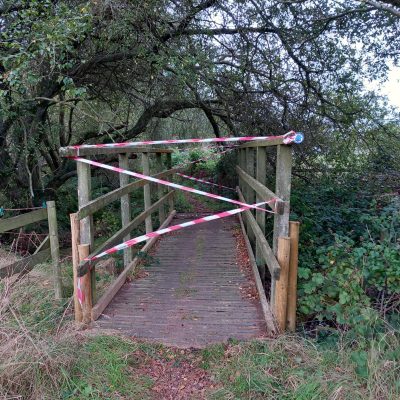
Most failing footbridges don’t collapse overnight. They decline gradually, with repeated repairs extending their life in the short term but increasing long-term cost and risk.
Common signs replacement should be considered:
- Structural components are deteriorating (rot, corrosion, instability)
- Repairs are becoming more frequent or costly
- The bridge no longer meets current load or safety expectations
- Ongoing maintenance is disrupting access or budgets
Timber-beamed footbridges present a particular challenge. While they may appear sound externally, structural beams can degrade internally over time. In many cases, this type of bridge begins to show significant structural issues within 7 – 10 years of installation, with unseen decay affecting beam integrity long before visible failure.
To extend usability, temporary fixes are sometimes introduced. One example is the addition of chicken wire or mesh to improve slip resistance. While well-intentioned, this can introduce new hazards. Dogs and other animals can catch their feet in the mesh, and broken or lifted sections can create trip risks for pedestrians. Over time, these measures often worsen the safety profile rather than improve it.
This creates a difficult position for asset owners, where a structure may appear serviceable but carries increasing underlying risk.
Why Replacement Is Often the More Practical Option
While repair may appear cost-effective initially, it often extends the lifecycle of a compromised structure rather than resolving the underlying issue.
A full replacement can:
- Restore safety and compliance in one step
- Reduce ongoing maintenance requirements
- Provide a longer design life with predictable performance
- Remove uncertainty around hidden structural deterioration
For timber structures in particular, replacement eliminates the risk of internal decay that cannot be easily monitored or reliably repaired, along with the need for short-term surface fixes that may introduce further hazards.
A Straightforward Replacement Approach
Modern modular bridge systems are designed to simplify the replacement process.
In many cases:
- The existing bridge is removed
- Foundations or abutments are assessed and reused where possible
- A new structure is installed with minimal disruption
This approach reduces installation time and limits the impact on the surrounding environment, while providing a structure with a known and reliable lifespan.
Talk to Bison About Replacement Options
If you’re assessing a failing footbridge, cycleway or bridleway bridge, Bison can provide practical guidance on whether repair or replacement is the better route.
We design and supply long-life bridge systems in recycled plastic or timber, supported by durable steel beams. By avoiding timber structural beams, the risk of hidden internal decay is removed, delivering a more predictable and durable solution trusted by councils and land owners across the UK.
Get in touch to discuss your site and explore suitable replacement options.
Related Products
Explore other solutions designed to complement your project. From durable outdoor structures to practical access and safety features, our range helps you create functional, long-lasting spaces.
Start Your Project Today
Quick to install, built to last and unbeatable in performance and value. Request a quote for bridges, boardwalks or any outdoor structure.