
Timber or Recycled Plastic Boardwalks? Weighing Up the Whole-Life Cost
November 10, 2026
If you’re planning a boardwalk, one of the first decisions is the material. Timber is the familiar choice, it’s natural, and it usually comes in with the lower quote. It’s an entirely understandable starting point, and for many outdoor structures it works well.
Boardwalks are a slightly special case, though, and that’s where a recycled plastic boardwalk is worth considering. They’re almost always built where the ground is wettest, across bogs, marshes, flood plains, riverbanks and waterlogged woodland, and those conditions are particularly hard on timber. So alongside the upfront price, it’s worth looking at what each material will cost to own over the life of the path. We’ve set out the main points below to help you weigh it up.
The upfront cost
Recycled plastic materials do cost more to buy than timber, and if you’re comparing quotes on materials alone, timber will look like better value.
Materials are only part of the picture, however. The labour, plant, groundwork, access and site management involved in installing a boardwalk are virtually the same whichever material is used. The crew, the machinery, the time on site and the care needed in a sensitive habitat don’t really change between timber and plastic decking.
That’s worth keeping in mind, because installation is a cost that comes round again each time a boardwalk is rebuilt, along with the cost of taking the old one out.
How long each material lasts
This is where the two options start to differ most.
A boardwalk’s posts usually sit in saturated soil, its bearers and joists can stay damp for months, and its deck boards are regularly wet, shaded and prone to algae and moss. In those conditions, even well-treated timber typically lasts around 10 to 15 years, and sometimes less where posts stand in permanently waterlogged ground. For comparison, our own specification data quotes an expected life of 15 years for a European Redwood deck on a structure built clear of the ground.
Re-Life recycled plastic is rot-proof and moisture-resistant. It doesn’t absorb water, decay, split or splinter, and it doesn’t need painting or preservative treatment. Re-Life 40 has a 60-year desired service life.
| Fully timber boardwalk | Re-Life 100% recycled plastic | |
|---|---|---|
| Typical life in damp ground | 10–15 years | 60 years (desired service life) |
| Rot and decay | Expected over time | None |
| Treatment or painting | Periodic | None |
| Splinters | Can develop with age | None |
| Recyclable at end of life | Limited (treated timber needs specialist disposal) | Yes, 100% |
Whole-life cost: timber vs a recycled plastic boardwalk
Over 60 years, a timber boardwalk in a wet location would typically be built four times, while a Re-Life boardwalk would usually be built once.
Each timber replacement involves new materials, a full reinstallation, and the removal and disposal of the old structure. To show how this can add up, the example below uses simple index figures rather than prices. It assumes recycled plastic materials cost 50% more than timber, installation costs the same for both, and the timber lasts 15 years.
On these assumptions, timber works out at around three and a half times the cost of recycled plastic over 60 years, with recycled plastic becoming the more economical option at the first timber replacement. Your own figures will vary, but because installation is repeated with each rebuild, the overall pattern tends to hold across a realistic range of prices.
There are also costs that don’t usually appear on a quote, such as ongoing repairs, path closures, staff time spent on inspections, and bringing machinery back into a sensitive habitat.
| Year | Fully timber boardwalk | Re-Life recycled plastic |
|---|---|---|
| 0: first install | 100 materials + 100 install = 200 | 150 materials + 100 install = 250 |
| 15: first replacement | + 30 removal + 200 rebuild = 430 | No cost: 250 |
| 30: second replacement | + 230 = 660 | No cost: 250 |
| 45: third replacement | + 230 = 890 | No cost: 250 |
| 60: running total | 890 | 250 |
Safety and maintenance
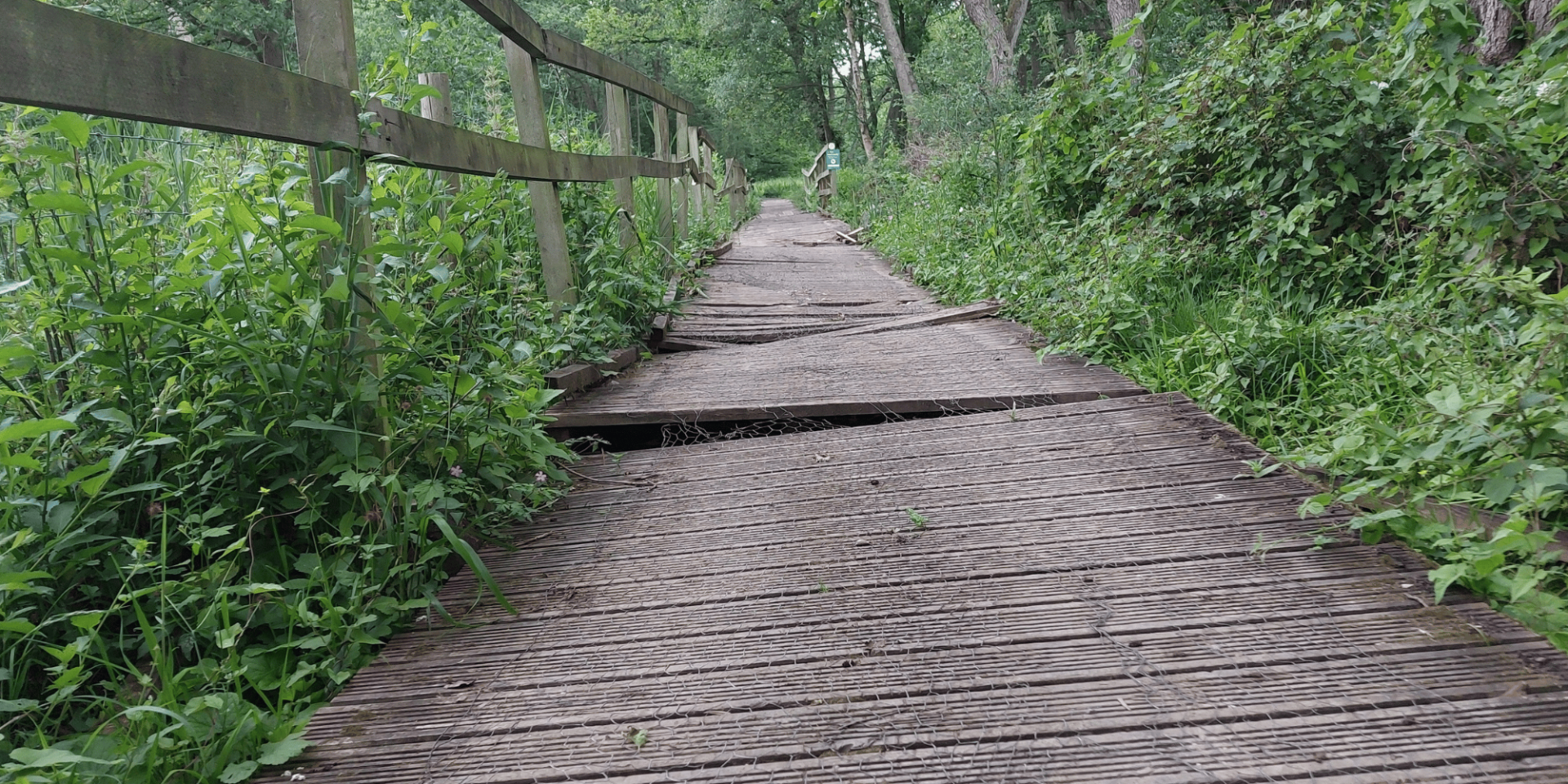
Many of us will have walked on a timber boardwalk with chicken wire stapled across it to improve grip. It’s a sensible short-term measure, but it’s often a sign that the timber is already wet, slippery and starting to deteriorate.
As timber ages in damp conditions, algae and moss can build up on the surface, making it slippery when wet. Boards can cup, split and splinter, and fixings may loosen as the surrounding wood softens. Rot also tends to begin out of sight, in posts below the waterline or within the substructure, so it isn’t always obvious from the deck how far it has progressed.
For site owners and managers, that can mean more inspections, more repairs and, at times, closing a path until it’s made safe. Chicken wire itself can also tear, lift and rust over time.
Re-Life deck boards are slip-resistance tested to BS 7976, stay splinter-free, and don’t rot from within, so the boardwalk stays in much the same condition over its working life.
Environmental considerations
Timber is often seen as the greener choice, and in many settings it can be. In a wet location with a shorter lifespan, though, the wider picture is worth considering.
Each time a decayed timber boardwalk is replaced, it has to be dismantled and removed. That brings machinery and vehicles back on site, disturbs the ground in the very habitat the boardwalk was built to protect, and leaves a quantity of preservative-treated timber that needs disposing of through the appropriate waste routes. With a rebuild every 10 to 15 years, new timber also needs to be felled, treated and transported each time.
Re-Life is made from 100% recycled plastic, giving waste plastic a long second life rather than sending it to landfill or incineration. Being installed once means one period of disturbance on site, and at the end of its service life it is 100% recyclable.
Re-Life boardwalks can also be installed on ground screw foundations, which need no excavation or concrete. This helps keep disturbance and embodied carbon down, and allows installation in wet or remote locations throughout the year.
Choosing the right grade of recycled plastic
If you do decide on recycled plastic, the grade matters a great deal.
Recycled plastic products vary widely. Economy grades are often made from mixed feedstock and are designed for lighter-duty uses such as planters, edging and garden furniture. In a load-bearing structure they may sag or deflect over time, especially over longer spans and in warm weather, so they aren’t well suited to boardwalks.
We supply Re-Life, which is manufactured in the UK from a blend of 100% high-quality recycled plastic from post-industrial and commercial sources, and is load tested to the relevant Eurocodes for high-footfall public sites. It has been installed at locations across the UK and performs well in all weather conditions.
Recent Re-Life projects include:
- National Trust, Carvers Rocks, Derbyshire: a timber bridge and boardwalk that had decayed in damp ground on an SSSI were replaced with an 8 m Bison Bridge and a 31 m Re-Life boardwalk with grooved, slip-resistant deck boards.
- RSPB Middleton Lakes, West Midlands: a decayed timber platform and boardwalk replaced with Re-Life on ground screw foundations, with no concrete or digging.
- A Dorset SSSI: 170 metres of 1.2 m wide Re-Life boardwalk replacing a failed timber structure across sensitive wetland, with passing places and turning bays.
Whichever supplier you speak to, it’s worth asking what grade of recycled plastic is being offered, whether it’s rated for structural use, and what testing and warranty sit behind it.
In summary
Timber usually has the lower upfront cost, and that’s a real consideration, particularly where budgets are tight. In the wet conditions most boardwalks face, though, recycled plastic tends to offer better value over the long term.
With installation costs much the same for both, the extra cost of Re-Life is a one-off. Over the life of the path, it can avoid repeated cycles of repair, removal and rebuilding, while staying safer underfoot and causing less disturbance to the site.
If you’re planning a new boardwalk, or looking at options for an ageing timber one, we’d be happy to talk it through. We can design and supply a Re-Life boardwalk to suit your ground conditions and footfall, advise on how to install it, and recommend approved installers if you need them.
Sources
- Bison Bridleway Bridge, NBS Source: redwood expected life, BS 7976 slip testing
- National Trust Carvers Rocks Bridge and Boardwalk, Built by Bison
- RSPB Middleton Lakes case study, NBS Source
- Dorset SSSI boardwalk case study, Lattira Source
Related Products
Explore other solutions designed to complement your project. From durable outdoor structures to practical access and safety features, our range helps you create functional, long-lasting spaces.


Start Your Project Today
Quick to install, built to last and unbeatable in performance and value. Request a quote for bridges, boardwalks or any outdoor structure.