






Footbridges, Pedestrian & Cycle Bridges
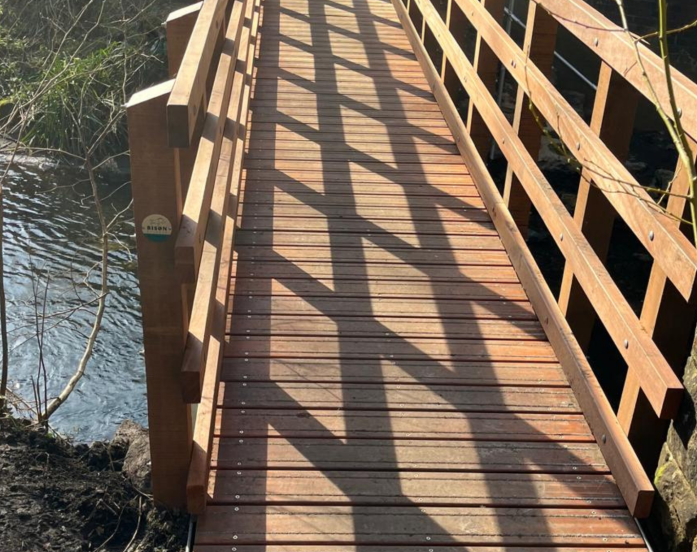
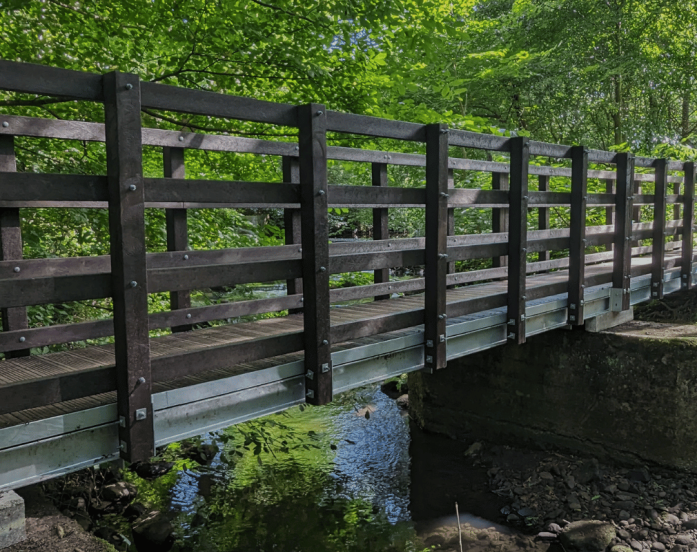
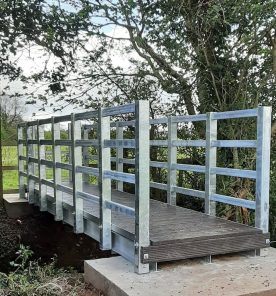
Bison footbridges provide safe, step-free crossings for footpaths, public rights of way, parks, nature reserves, greenways and private estates. Designed for both pedestrian and cycle use, with spans from 3 metres to 16 metres and deck widths up to 2.4 metres.
Popular 3m to 10m spans are held in stock for fast UK delivery — useful when a crossing has failed and a path is closed. Longer and bespoke spans are made to order.
Every bridge is engineered to Eurocode standards and supplied in kit form with pre-drilled components, so it can be bolted together on site — including at remote locations with no vehicle access.
For crossings used by horses, see our bridleway bridges, designed to a higher 7.0 kN point loading.
Product Details
Footbridge Specifications
| Specification | Detail |
|---|---|
| Span lengths | 3m to 16m clear span, in 1m increments |
| Stock spans | 3m to 10m held in stock for fast UK delivery |
| Standard widths | 800mm, 1200mm, 1800mm, 2400mm |
| Structural beams | Hot-dip galvanised steel, 85-micron zinc coating |
| Deck material | Pressure-treated Redwood, hardwood, Re-Life Recycled Plastic or perforated steel |
| Deck loading | 5.0 kN/m² (pedestrian and cycle use) |
| Deck surface | Anti-slip inserts as standard |
| Design standard | BS EN 1990:2002+A1:2005 Eurocode | BS EN 1991-2:2003 |
| Suitable for | Footpaths, public rights of way, greenways, shared-use and active travel routes, parks and estates |
| Supply format | Kit form — bolt together on site, or supplied pre-assembled |
Spliced beams are available on longer spans for easier handling and transport to site. All kits are supplied with pre-drilled components, structural drawings and assembly guidance.
How Wide Should a Footbridge Be?
Deck width is the specification decision most often got wrong, and the hardest to put right afterwards.
For public rights of way, accessibility guidance recommends that new bridges are step-free, have sturdy guard rails, and are at least 1.5 metres wide — enough for a wheelchair or mobility scooter to cross, and for two people to pass. Of our standard widths, 1800mm meets this; 1200mm does not.
- 800mm — private land and estate crossings, single-file access, no public right of way
- 1200mm — lightly used rural footpaths where a wider deck cannot be accommodated
- 1800mm — recommended minimum for public rights of way and any route where accessibility matters
- 2400mm — shared pedestrian and cycle routes, busy public paths, and sites needing maintenance vehicle access
If the bridge sits on a definitive map or is being installed under a public path order, your local authority rights of way team will have a view on width before you order. It is worth asking early.
Cycle, Shared-Use and Active Travel Routes
Bison footbridges are designed to 5.0 kN/m², which covers both pedestrian and cycle use — the same structure serves a rural footpath or a greenway.
What changes is the deck width. On shared-use and active travel routes, where cyclists need to pass walkers safely, a 2400mm deck is normally specified. Parapet height and infill also matter more where cyclists are carrying speed: vertical infill panels or spindle parapets are commonly specified on NMU (non-motorised user) routes in place of open rails.
We supply bridges for greenways, disused railway paths, canal towpath links, country parks and active travel schemes for local authorities and developers across the UK.
Timber vs Recycled Plastic Decking
Pressure-treated Redwood timber offers a traditional aesthetic well suited to parkland, estate and conservation settings. Re-Life Recycled Plastic decking is naturally slip-resistant, maintenance-free and manufactured from 100% post-consumer waste, making it the preferred choice for wet, shaded or exposed sites and for long-term, low-maintenance installations. Hardwood and perforated steel decks are also available where a specific aesthetic or drainage requirement applies.
Pricing
Footbridge kits with redwood decking and parapets start from £2,510 plus delivery and VAT. Recycled plastic deck options start from £2,863 plus delivery and VAT. The final cost depends on span length, deck width, material choice, parapet specification and delivery location. Use the bridge tool below or call us on 01530 242 405 for an accurate quotation.
What to Consider When Specifying a Footbridge
When specifying a footbridge for a public right of way, park, greenway or estate crossing, four factors matter most: span, deck width, deck surface and how the bridge will reach the site.
Measure the crossing, not the gap. The span you need is the distance between where the beams will bear, not the width of the watercourse. Banks erode, and abutments need firm ground set back from the edge. Our guide to measuring a bridge crossing covers this in detail.
Check who consents the work. A bridge over an ordinary watercourse usually needs consent from the lead local flood authority or internal drainage board; a main river means the Environment Agency. On a public right of way, the highway authority will need to approve the structure.
For remote or restricted-access sites, the kit supply format is a key advantage: all components are pre-drilled and can be carried in manually, then bolted together on site without specialist equipment.
Consider whole-life cost rather than purchase price. Galvanised steel beams with an 85-micron zinc coating give an initial service life of approximately 56 years before major maintenance is required in typical inland UK locations.
Frequently Asked Questions
What is the difference between a footbridge and a pedestrian bridge?
There is no technical difference — the terms are used interchangeably in the UK. “Footbridge” is the term used in most local authority and public rights of way documentation; “pedestrian bridge” is more common in engineering specifications and among landscape architects. Both describe a bridge designed for people on foot, typically to a crowd loading of 5.0 kN/m². You may also see them called footpath bridges, foot bridges or simply crossings.
Do you have footbridges in stock?
Yes. Popular spans from 3m to 10m are held in stock for fast UK delivery, which matters when a bridge has failed and a path is closed under a temporary closure order. Longer spans and bespoke widths are made to order — contact us for current lead times.
How much does a footbridge cost?
Bison footbridge kits start from £2,510 plus delivery and VAT for a timber deck, or £2,863 plus delivery and VAT for recycled plastic. Cost rises with span and width. Groundworks, abutments and installation are additional and vary considerably by site — see our guide to the cost of replacing a footbridge.
What spans are available?
Spans run from 3m to 16m in 1-metre increments, with 3m to 10m held in stock. Spliced beams are available on longer spans for easier handling. Non-standard and bespoke sizes can be accommodated — contact us to discuss your requirements.
What loading does a footbridge need to be designed for?
Pedestrian and cycle bridges are designed for a crowd loading of 5.0 kN/m², in accordance with BS EN 1990:2002+A1:2005 and BS EN 1991-2:2003. If horses will use the crossing, a higher 7.0 kN point loading applies — see our bridleway bridge range.
Can a footbridge be used by cyclists?
Yes. Bison footbridges are rated for both pedestrian and cycle use at 5.0 kN/m². For shared-use and active travel routes a wider deck is normally specified — 2400mm allows pedestrians and cyclists to pass comfortably.
Do I need planning permission for a footbridge?
Planning permission is not usually required for a footbridge on agricultural land or an existing right of way, but consent from the relevant drainage authority almost certainly is. Check with your local planning authority, and with the Environment Agency, internal drainage board or lead local flood authority depending on the watercourse. We can supply drawings and specifications to support an application.
How long does a footbridge last?
Hot-dip galvanised steel beams with an 85-micron zinc coating provide an initial service life of approximately 56 years before major maintenance is required in typical inland UK locations. Recycled plastic decking is unaffected by rot and requires minimal maintenance. Redwood timber decking is pressure-treated and should be inspected periodically.
How are footbridges installed?
Bison footbridges are supplied in kit form — all components are pre-drilled and bolt together on site with basic hand tools. Full assembly drawings and guidance are included. This is particularly useful for remote locations where vehicle access is limited, as components can be carried in manually. We can recommend approved installers across most of the UK for a full supply-and-install service.
Do you supply footbridges for public rights of way?
Yes. Bison footbridges are widely used by county and district councils, parish and town councils, national parks, wildlife trusts and landowners on rural rights of way, countryside access schemes and Countryside Stewardship projects across the UK. We can provide specifications, structural drawings and design certificates to support grant applications and public path orders.
Related Products
Explore other solutions designed to complement your project. From durable outdoor structures to practical access and safety features, our range helps you create functional, long-lasting spaces.


Start Your Project Today
Quick to install, built to last and unbeatable in performance and value. Request a quote for bridges, boardwalks or any outdoor structure.