
Gates for Rights of Way
What is a Kissing Gate?
August 6, 2026
What Is a Kissing Gate?
Design, accessibility and BS 5709:2018 compliance – a specifier’s guide for councils,
estates, contractors and countryside access teams
A kissing gate is a self-closing pedestrian gate that swings inside a small enclosure, usually
shaped like a V, a U, a circle or a square. The gate never latches shut in the conventional sense.
It rests against one side of the enclosure, and a walker moves it across to the other side in order
to step through. People pass one at a time. Livestock stay where they are.
The name comes from the way the gate touches, or “kisses”, each side of the enclosure as it swings,
rather than from anything more romantic. It is one of the most commonly specified structures on public
rights of way in the UK.
How a Kissing Gate Works
The mechanism is simple, which is exactly why it has lasted. The user pushes the gate away from the side
it is resting against and steps into the enclosure. The gate is then moved back across, and the user steps
out on the far side. Because the enclosure surrounds the swing of the gate, there is never an open,
unobstructed line through the structure. A cow or sheep following behind finds no gap to walk through.
On a well-specified gate the hinge does the work. Bison kissing gates are self-closing, so the gate returns
to rest on its own and the path stays stockproof whether or not the last person through was paying
attention.
Why Specify a Kissing Gate Instead of a Stile?
Under the principle of least restrictive access, the aim on any right of way is to use the most accessible
structure that still meets the land management need. The hierarchy runs roughly:
1) No structure at all – the most accessible option
2) A gap
3) A gate
4) A kissing gate
5) A stile – the more restrictive option
A stile requires a user to climb. That rules out wheelchair users, most mobility scooter users, many older
walkers, people with dogs and anyone with a pushchair. A kissing gate requires no climbing, so it sits
considerably higher up the hierarchy while still controlling livestock and deterring motorbikes.
For local authorities this matters beyond good practice. The public sector equality duty under the Equality
Act 2010 requires authorities to have due regard to the needs of disabled people when making decisions
– including decisions about what goes on a footpath. Replacing a failed stile with a like-for-like stile is
increasingly difficult to justify.
Enclosure Types and What They Mean in Practice
V-shaped and U-shaped enclosures
The traditional form. Compact, economical and effective on tight rural footpaths, but the narrowing
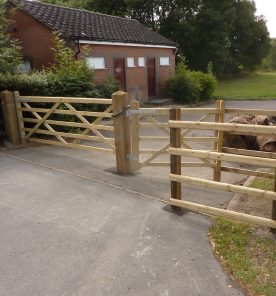
enclosure limits the turning space available. Suited to pedestrian-only routes. See the Atherstone
Pedestrian Kissing Gate, a timber V-enclosure gate.
Circular and rounded enclosures
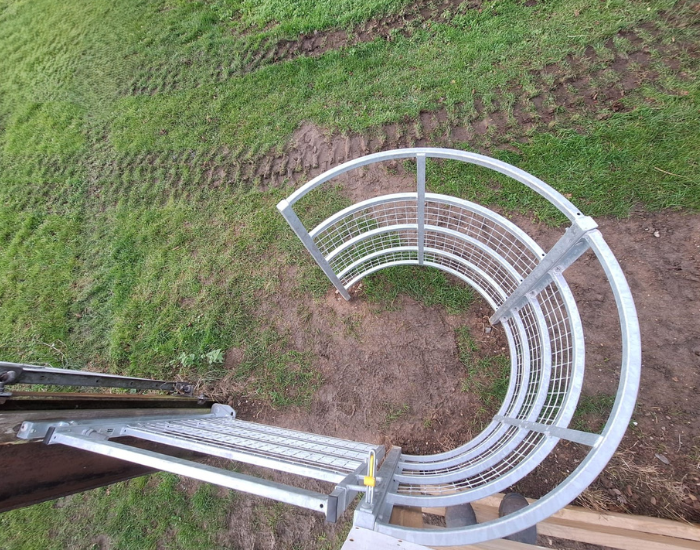
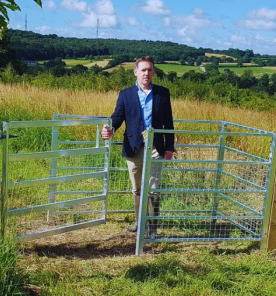
A rounded hoop keeps the gate captive within the kissing posts while giving slightly more usable space
than a tight V. The Berkswell Pedestrian Kissing Gate uses this configuration in galvanised steel.
Square and rectangular enclosures
A larger footprint with far more room to manoeuvre. This is the configuration used on mobility kissing
gates, where a wheelchair or pushchair user needs space to enter, allow the gate to pass, and exit without
reversing. See the Matlock Medium Mobility Kissing Gate in steel, or the Medbourne Medium Mobility
Kissing Gate in timber.
Oversized enclosures with RADAR locks
For the highest level of accessibility, an oversized hoop is dimensioned to allow 180-degree manoeuvring
for category 3 mobility scooters and large wheelchairs. A RADAR lock lets the gate swing fully open for
key holders while behaving as a standard kissing gate for everyone else – useful for path maintenance
machinery too. See the Thornton Large Mobility Kissing Gate with RADAR Lock in steel, or the Medbourne
Large Mobility Kissing Gate in timber.
Kissing Gates and BS 5709:2018
BS 5709:2018 Gaps, gates and stiles – Specification is the British Standard governing new structures on footpaths, bridleways, restricted byways and other routes used by the public. It came into effect on 28 February 2018, superseding BS 5709:2006.
Two points are commonly misunderstood. First, the standard sets field-measurable performance requirements rather than prescribing one approved design. Several kissing gate designs can be compliant, provided they meet the relevant requirements.
For kissing gates, sufficient internal manoeuvring space must be provided to allow a 1,000 mm diameter cylinder to pass through with its flat end on the ground. The gate must also swing freely and require no more than 18 N of force to open fully.
The Standard notes that kissing gates are inherently more restrictive than pedestrian gates and should only be used where there is a specific requirement. Where the distance from the gate to the end of the enclosure is less than 1,600 mm, a RADAR-operated bypass arrangement is strongly recommended to accommodate Class III mobility vehicles.
Second, the Standard does not apply retrospectively to most existing structures. It applies to new work. Where an old gate is being repaired or replaced, however, it is the sensible benchmark, and most specifiers now treat it as such.
Materials and Long-Term Performance
A kissing gate on a well-used route can be operated tens of thousands of times over its life, in mud, frost
and driving rain. Two things tend to fail first: the finish, and the alignment of the posts.
Hot-dipped galvanised steel handles the first. For the second, the detail worth looking for is a
below-ground H frame connecting the hanging post to the closing post. It holds the posts at a fixed
spacing and stops them drifting out of line under years of pushing and pulling. If the hanging post leans, a
self-closing gate stops closing cleanly – and a gate that does not close is not a stockproof gate. Read
more on H frames
Where a traditional rural appearance is required, UC4-treated timber gates offer a 15-year desired service
life. Stock-proof mesh to the lower half is worth specifying where lambs or poultry are a consideration.
Anti-tamper fixings are worth specifying more or less everywhere.
The Bison Kissing Gate Range
| Product | Material | Enclosure | Suited to | Key dimensions | Notes |
|---|---|---|---|---|---|
| Berkswell Pedestrian Kissing Gate | Steel | Circular | Pedestrian | H 1.1m · leaf 1.02moverall 2.0m | Stock item |
| Matlock Medium Mobility Kissing Gate | Steel | Square | Wheelchair, pushchair | H 1.1m · leaf 1.13moverall 2.3m · depth 1.25m | Stock item BS 5709:2018 |
| Thornton Large Mobility Kissing Gate with RADAR Lock | Steel | Oversized rectangular | Cat. 3 scooters, large wheelchairs | H 1.05m · leaf 1.13moverall 2.3m · depth 1.25m | Stock item BS 5709:2018 |
| Atherstone Pedestrian Kissing Gate | Timber | V | Pedestrian | H 1.20m · leaf 1.20moverall 2.45m | UC4 treated |
| Medbourne Kissing Gate – Medium Mobility | Timber | Square | Wheelchair, pushchair | H 1.20m · leaf 1.20moverall 2.40m | UC4 treated |
| Medbourne Mobility Kissing Gate – Large Mobility | Timber | Square (generous) | Mobility vehicles | H 1.20m · leaf 1.20moverall 3.0m | UC4 treated |
Choosing the Right Gate
Match the gate to the users, not just to the fence line.
- Pedestrian routes, no significant mobility requirement – a standard pedestrian kissing gate: Berkswell (steel) or Atherstone (timber).
- Wheelchair and pushchair access expected – a square-enclosure medium mobility gate: Matlock or Medbourne Medium. Note that a medium enclosure is not large enough for mobility scooters.
- Larger mobility vehicles – an oversized enclosure with a RADAR lock: Thornton or Medbourne Large.
- Bridleways and equestrian routes – a kissing gate is the wrong structure. Specify a bridle gate such as the Compton, Rutland or Hampshire.
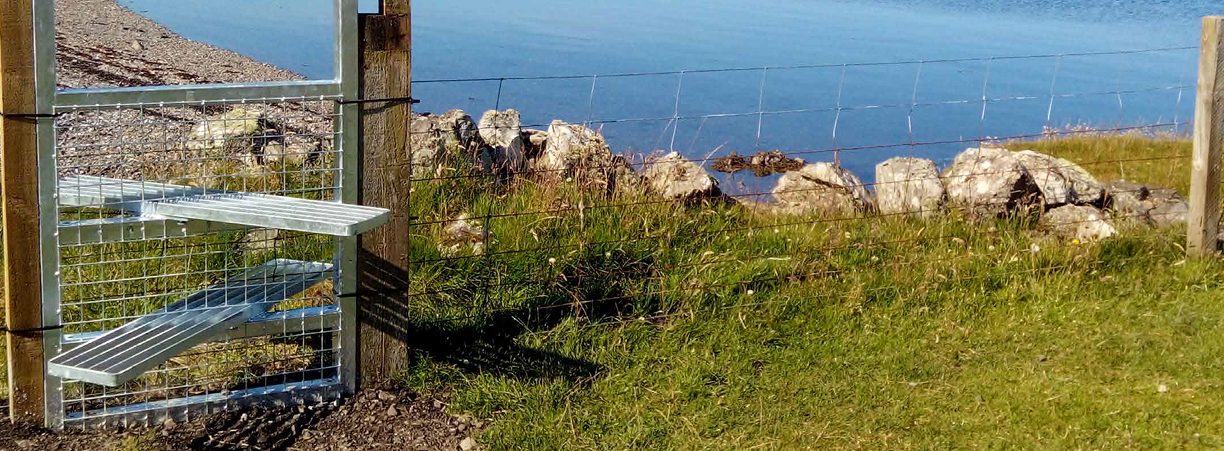
- Where a stile is required – consider the Shetland Steel Stile Kit, and pair it with a Barkers Dog-Way Stile Gate so dog walkers are not excluded.
Frequently Asked Questions
Why is it called a kissing gate?
Because the gate touches, or “kisses”, each side of the enclosure as it swings between them.
Are kissing gates wheelchair accessible? Some are. A traditional V-shaped gate usually is not. A square-enclosure mobility kissing gate is designed to be, and an oversized RADAR-locked gate extends this to larger mobility vehicles.
Do you need permission to install a kissing gate on a public footpath?
Yes. New gates on a public right of way require authorisation from the highway authority under the Highways
Act 1980, and are normally justified on livestock control grounds.
What is the minimum width for a kissing gate?
BS 5709:2018 is commonly cited as requiring a minimum clear width of 1.1m on footpaths and 1.525m on
bridleways.
Kissing gate or stile?
A kissing gate, wherever the land management need allows it. Stiles are a more restrictive structure.
Can a kissing gate be hung left or right handed?
On Bison steel gates, yes. A reversible D loop striker and self-closing hinge allow interchangeable right or left hand opening, so there is no need to order handed gates.
Ready to specify?
Bison supplies BS 5709:2018 compliant steel kissing gates as stock items, with integral H frame posts,
self-closing hinges, anti-tamper fixings and a hot-dipped galvanised finish as standard, backed by a 7
year guarantee. Timber alternatives are available where a traditional appearance is required.
This guide is provided for general information. Dimensional and compliance requirements should be confirmed against the current text of BS 5709:2018 and with the relevant highway authority before specification.
Related Products
Explore other solutions designed to complement your project. From durable outdoor structures to practical access and safety features, our range helps you create functional, long-lasting spaces.
Start Your Project Today
Quick to install, built to last and unbeatable in performance and value. Request a quote for bridges, boardwalks or any outdoor structure.